
Drafted. Sent.Reconciled.

Purchase orders generated from a signed proposal or project BOM, split by supplier in one click, sent direct to selected AV distributors with live pricing, and auto-reconciled against goods received.

Drafted.Sent.Reconciled.

One-click POs

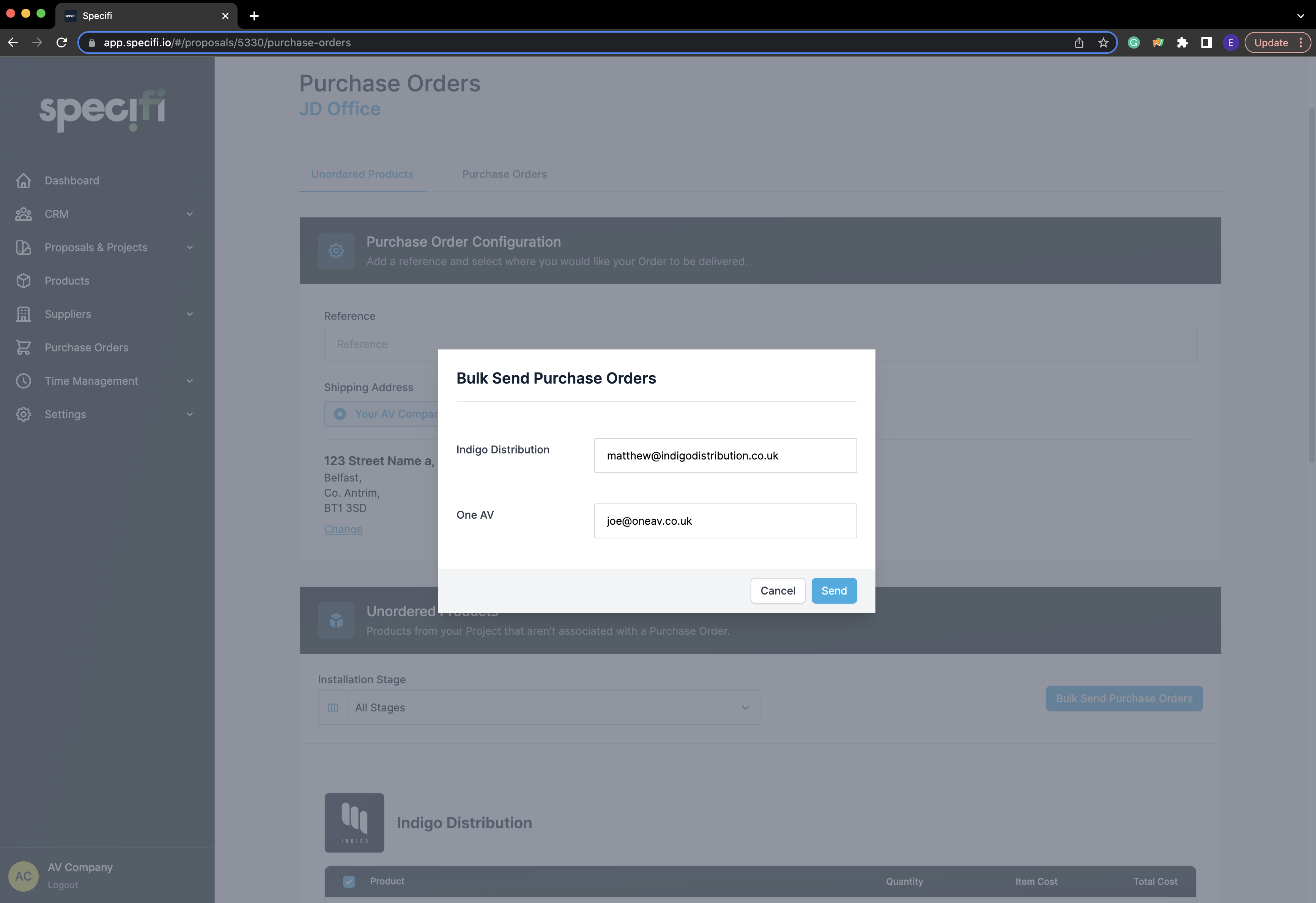
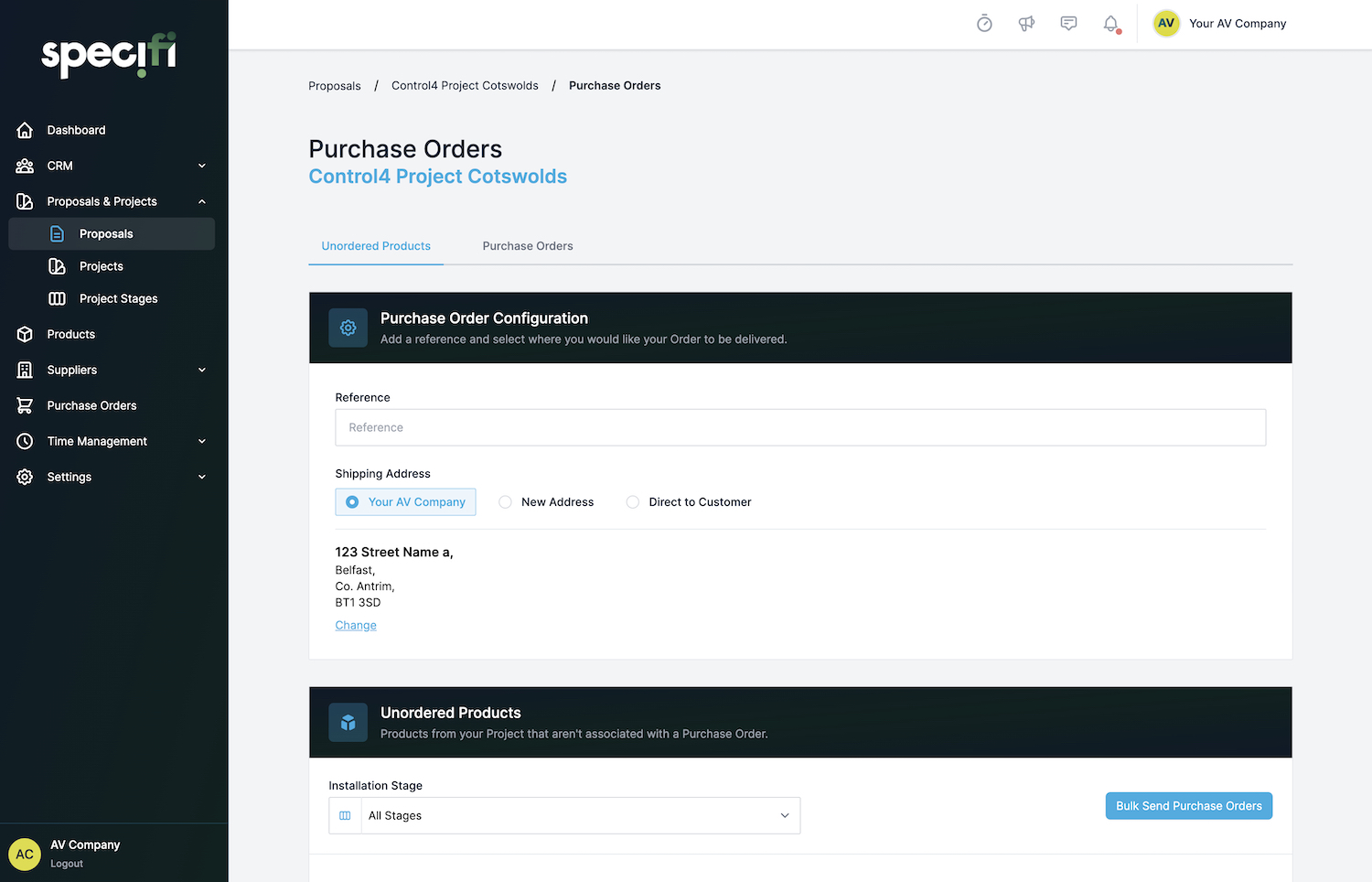
Raise a PO from a signed proposal, a project bill of materials, an inventory shortfall, or a Bob the AI top-up draft. Supplier, line items, manufacturer codes, supplier-specific SKUs, and live pricing pre-filled from the project record. The PO presents for review, the integrator clicks send, the email lands in the supplier's inbox with a Specifi tracking ID stamped in the subject line so confirmation replies match back automatically.

Live supplier pricing

Connected suppliers send live pricing into Specifi (selected major AV distributors today; the live procurement flow extends across more connected suppliers from 1 June 2026 with the inventory release). The cost basis on the proposal, the cost basis on the PO, and the cost basis on the project margin view are all the same number, refreshed against the supplier's current cost not against a stale price list someone exported into a spreadsheet six months ago.

Multi-supplier split

A single project BOM splits across the four to six suppliers a typical AV install pulls kit from. Specifi groups the line items by supplier, drafts one PO per supplier, and sends them all in one click with the right kit on the right document. Each supplier sees only what is for them; the integrator sees the consolidated dispatch view across all of them on the project record.

Stage-based scheduling

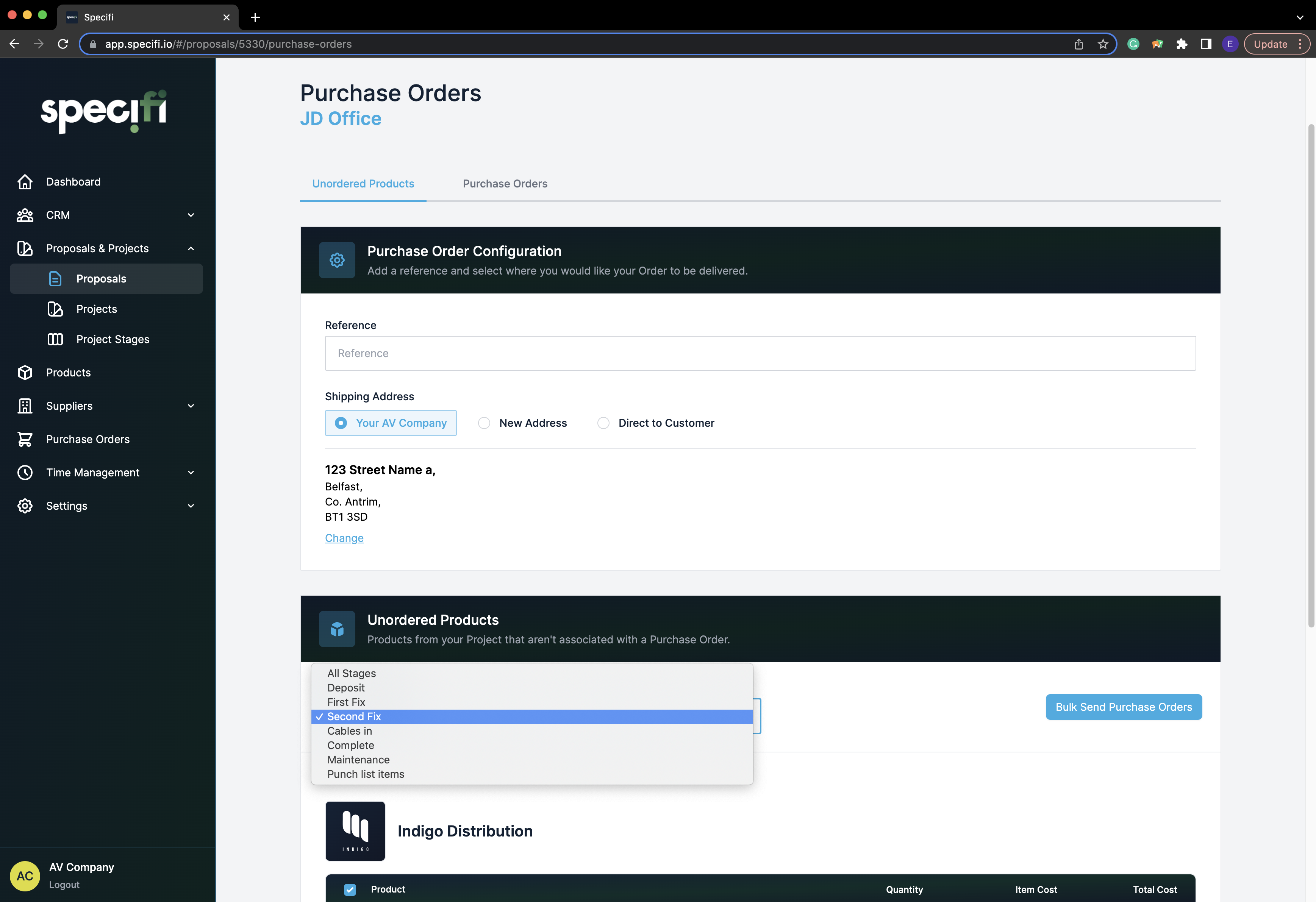
Schedule POs by project phase so first-fix kit does not arrive the same day as commissioning gear. Less clutter on site, less inventory tied up in the van, fewer handover-week phone calls about kit that has been sitting in a cardboard box for three weeks. Stage-based PO scheduling shares state with the work-order dispatch view, so the procurement and the field-app calendars are looking at the same project rhythm.

Delivery reconciliation

POs auto-reconcile against goods received at the van door. Quantities matched, model and serial numbers captured, variance flagged on the project record (eight units invoiced, seven units arrived = one unit on the chase list, not eight units silently posted as fully delivered). Inventory updated. Project cost posted. Backorders surfaced. Returns flagged. The reconciliation that used to happen at month-end on a spreadsheet happens at the van door on the day.

Bob the AI on procurement

Ask Bob in plain English: "Which POs are open with this supplier?", "What's outstanding from the Riverside cinema-room project?", "How much have we spent on speakers this quarter?", "Which orders are flagged variance against received?" Bob queries the live PO ledger, supplier acknowledgements, and project cost postings, and answers in seconds. Today, Bob is read-only on procurement. From 1 June 2026, Bob also drafts purchase orders against a project bill of materials: you review the lines, supplier, pricing, and quantities in the standard PO screen, then send when ready. Bob never finalises a PO without your approval.

Why integratorsmake the switch.

No retyping

The line items, the supplier-specific SKUs, the manufacturer codes, the live pricing, and the project tracking ID are all pulled from the project record. Raising a PO is a click, not a thirty-minute spreadsheet rebuild plus an email draft plus a manual transcribe of the supplier's acknowledgement number into a third spreadsheet.

Costs captured

Every line item against every PO posts against the project the moment the supplier acknowledges the order. Project margin reflects current procurement reality, not last month's spreadsheet snapshot. Margin problems caught at week six are rescuable; margin problems caught at month-end close are losses.

No receive drift

Goods received reconciled against POs at the van door. Eight units invoiced, seven units arrived = one unit on the chase list, not eight units silently posted as fully delivered with the missing unit only discovered three weeks later when the technician opens the rack at first-fix. Shortages caught on day one, not on week three.

Commonquestions

Contact us
What is Order Products, in plain terms?

The procurement surface of the Specifi platform. A signed proposal carries a list of products: amplifiers, speakers, projectors, screens, in-wall cabling, lighting-control modules, racks, and the dozens of other line items a typical AV project pulls together. Order Products takes that list and turns it into the right purchase orders against the right suppliers in one click: the rack-mounted electronics go to the AV distributor, the projector and the masking go to the screens specialist, the keypads and the dimming go to the lighting-control distributor, the recliner seating goes to the furniture brand. Each PO carries the right line items, the live supplier pricing, the manufacturer codes, the supplier-specific SKUs, and a Specifi tracking ID stamped on the email subject line so the supplier's confirmation reply matches back to the parent project record automatically.

Which suppliers are connected for live procurement?

You can raise a PO for any supplier in your account, connected or not, including customer-supplied equipment records. For selected major AV distributors, the procurement flow goes further: live pricing flows into proposals and POs, orders ship to the supplier with their SKUs on the line items, and acknowledgements come back through Specifi automatically.

The named list of distributors with live procurement varies by region (UK, US, IE, CA, AU, NZ). Ask during a demo and we'll share the current list for your region.

From 1 June 2026 with the inventory release, the live procurement flow extends across more connected suppliers. Goods-received reconciliation against POs, with variance flagging on quantity, model, and serial number, lands in the same release.

Can I add my own suppliers if they are not connected for live procurement?

Yes. Non-connected suppliers can be added manually with a per-supplier product library, per-supplier pricing (cost basis + RRP), per-supplier payment-terms metadata, and per-supplier contact details. POs raised against a manual supplier carry exactly the same in-product surface as POs against a connected distributor: line items, manufacturer codes, supplier-specific SKUs, project tracking ID, PDF generation, and the email-with-tracking-ID send pattern. The difference is that pricing on a manual supplier is what you put into the price-list table (with a "last verified" date stamp) rather than streamed live from a connected feed; if your manual supplier raises prices, you update the price list and the cost basis on the next PO refreshes against that update.

This matters for AV integrators whose business model includes a long tail of niche suppliers (custom-cabling specialists, regional furniture brands, one-off lighting fabricators) outside the big-box distributor coverage. The platform does not penalise that long tail: a manual supplier is a fully-fledged supplier inside Specifi, just without the live-pricing feed.

How does proposal-to-PO conversion work in practice?

A signed proposal carries every line item the integrator will install: the £8,400 worth of in-wall speakers, the £14,200 lighting-control package, the £4,200 7.2-channel processor, the £1,800 worth of CAT6 and conduit, line by line. Specifi already knows which of those line items map to which supplier (because the line items are linked to manufacturer-and-distributor metadata at proposal time, not retroactively at PO time). Clicking "Generate POs" on a signed proposal drafts one PO per supplier, with the right items, the right quantities, and the live cost basis pulled from the connected feed (or from the manual supplier's price list, with the last-verified stamp visible).

The integrator reviews the draft POs, edits any pre-fill the project context did not catch (a substituted product because the supplier is short-stocked, a quantity adjustment because the survey caught a longer cable run than expected), and clicks send. The POs go out to suppliers with a Specifi tracking ID stamped on the email subject line; supplier confirmations match back to the parent project record automatically.

How does the multi-supplier split work?

A typical residential cinema-room project pulls kit from four to six different suppliers: a primary AV distributor for the rack and the electronics, a screens specialist for the projector and the masking, a furniture brand for the recliner seating, a custom-cabling supplier for the longer in-wall runs, and the lighting-control distributor for the keypads and the dimming module. Specifi splits a single project bill of materials into the right per-supplier purchase orders, drafts one PO per supplier with only that supplier's line items, and sends them all in one click.

Each supplier sees only what is for them on their PO PDF: the screens specialist does not see the recliner-seating spec, the lighting-control distributor does not see the rack-mounted processor spec. The integrator sees the consolidated dispatch view across all suppliers on the project record, with each supplier's confirmation, dispatch, and delivery state tracked against the parent project. No more spreadsheet-cross-referencing five different supplier inboxes to figure out who has acknowledged and who is silent.

Can I schedule POs by project stage rather than send everything at once?

Yes. First-fix kit (cable, back-boxes, in-wall mounts, conduit) does NOT need to arrive the same day as commissioning gear (rack-mounted electronics, programming licences, calibration tools). Specifi schedules POs by project phase: first-fix, second-fix, commissioning, handover. Tag each line item or each PO to the phase it belongs to and Specifi releases the PO to the supplier on the trigger date for that phase, automatically.

Less clutter on site, less inventory tied up in the integrator's van, fewer handover-week phone calls about kit that has been sitting in a cardboard box for three weeks. Stage-based PO scheduling shares state with the work-order dispatch view, so the procurement view and the field-app calendars are looking at the same project rhythm.

How does delivery reconciliation work?

POs auto-reconcile against goods received at the van door. The technician scans the inbound delivery, the platform matches model and serial numbers against the open POs, quantities match against the PO line items, variance is flagged on the project record (eight units invoiced, seven units arrived = one unit on the chase list, not eight units silently posted as fully delivered with the missing unit only discovered three weeks later when the technician opens the rack at first-fix). Inventory levels update on receipt. Project cost posts on supplier acknowledgement.

This release of the reconciliation surface lands on 2026-06-01 with the inventory module ship. Today, goods-received variance is captured manually against the open PO record; the auto-reconciliation against scanned model and serial numbers ships with the inventory module.

What about backorders and partial receipts?

Both supported. A PO that ships partial (eight units invoiced, six arrived on the first delivery, two on backorder for a fortnight) is preserved on the PO record as partially received with the outstanding quantity flagged and chased. The chase list surfaces in the project manager's project-status view ("two units of [SKU] outstanding from [supplier], expected [date]") so handover-week kit gaps are caught at week six, not at week ten.

When the backordered shipment lands, the same reconciliation flow runs (model match, serial capture, quantity match, variance flag if any) and the PO state moves from partially received to fully received. The project margin view updates against the actual cost basis on the second shipment if the supplier raises a price between the partial and the back-order.

Are returns and RMAs supported?

Yes. With the inventory module, returns and RMAs are fully supported. Live for beta customers today, broad release on 1 June 2026.

A return raised against a delivered PO captures as a credit-note line on the supplier record, with the RMA reference, the reason code (DOA, damaged in transit, wrong product shipped, surplus to project), and the value of the credit. The credit posts back against project margin when the supplier acknowledges it. A £620 amplifier returned because the survey caught a different room layout adds £620 back into the project margin once the supplier's credit lands.

Can I raise POs in multiple currencies?

No. POs are raised in your account's base currency. Specifi runs in a single currency per account: GBP, USD, EUR, AUD, NZD, or CAD set at account level, no per-PO override.

If your account base is GBP and you're buying from a German distributor invoiced in EUR, you handle the FX between yourself, the supplier, and your bank. The project cost records what you paid in your base currency.

If procurement across currencies is a regular part of your business, Specifi won't capture the FX variance for you today.

How does the supplier-side workflow look from their end?

The supplier receives a clean, professionally-formatted PO PDF on company-letterhead branding (the integrator's logo, address, tax registration number, project tracking reference, line items, supplier-specific SKUs, quantities, agreed pricing, payment terms, delivery address). The PDF is attached to the email; the email subject line carries the Specifi tracking ID so the supplier's reply (acknowledgement, query, dispatch confirmation) matches back to the parent project record automatically when the supplier hits reply-all.

For connected suppliers on the live procurement flow, the integrator's PO also lands in the supplier's order-management system through the connected feed, so the supplier-side admin surface is updated without manual re-keying. For non-connected suppliers, the workflow is email + PDF + matched-reply tracking, which is how most AV distributor relationships have always worked; the difference is that the integrator-side admin retires (no more transcribing the supplier's confirmation number into a third spreadsheet, no more chasing email threads for the dispatch state).

Can Bob the AI help with procurement?

Yes. Ask Bob in plain English: "Which POs are open with this supplier?", "What's outstanding from the Riverside cinema-room project?", "How much have we spent on speakers this quarter?" Bob queries the live PO ledger, supplier acknowledgements, and project cost postings, and answers in seconds.

Today, Bob is read-only on procurement. From 1 June 2026, Bob can also draft purchase orders against a project bill of materials. You review the lines, supplier, pricing, and quantities in the standard PO screen, then send when ready. Bob never finalises a PO without your approval.

Included on every Specifi plan. No AI surcharge, no per-prompt token cost.

What does Order Products cost?

Nothing extra. Included on every Specifi plan: Individual, Team, Company, all-region. No per-PO platform fee. No per-supplier-connection charge. No premium-tier upgrade gating live-pricing feeds, multi-supplier split, stage-based scheduling, delivery reconciliation, or the Bob the AI procurement surface. The platform-side procurement surface is unmetered the same way the proposal, the project, the work order, the invoice, and the customer portal are unmetered.

The exception is volume-driven supplier-side fees that are between you and the supplier (a distributor's small-order surcharge on POs under a minimum value, a courier-delivery fee on a 24-hour shipment), which Specifi captures and posts to the project margin transparently but does not touch with a Specifi-side surcharge.

They switched. Theyhaven't looked back.

Specifi is an amazing software that literally runs our business operations. From initial proposals, sales and CRM to team and project management, invoicing & generating purchase orders. I would definitely recommend Specifi to anyone running a small to medium size audio visual or electrical company that wants a simple to use software that gets the business organised and looking super professional.
James BrownThe Cinema Company
Specifi has significantly improved the efficiency of our day-to-day business operations. The software is incredibly easy to use and has helped us create an organised and streamlined setup. Their aftersales service is outstanding; they're always available to assist and consistently roll out updates with valuable new features. This commitment to ongoing improvement sets them apart. I highly recommend it.
Miguel AttardDomotica Systems
We chose Specifi for its modern interface, streamlined project timelines, and advanced time management and proposal software. Specifi has streamlined our process from start to finish, and provides a more professional appearance to our clients. Their support is superb, often fixing issues within minutes of them being reported. They're innovating at a much faster pace than others in the space.
Waylon MoreySunrise Smart Home

Ready to see it?

30-minute demo. No slides. No fluff.

Explore pricing