

Every AV business I have worked with has, at some point, built the same spreadsheet. Four tabs: brands, SKUs, cost band, RRP. Someone in the office maintains it. Someone else in the office secretly does not trust it. The new starter is told never to touch it. I run product data at Specifi, so I am going to spend this article on the bit nobody outside our office gets to see: what is actually in the catalogue, and how we stop it rotting.
What a real catalogue entry carries
A line item in the Specifi catalogue is not a name and a price. It is a record with the fields the integrator needs to write a credible proposal AND the fields the project manager needs to actually install the thing. Specifically:
- Manufacturer SKU and supplier SKU. Not the same number. The supplier reseller code is what your purchasing team types into the supplier portal. The manufacturer SKU is what your client googles.
- Cost band. Dealer net, by region. A US dealer pays a different number than a UK dealer for the same processor. The catalogue carries both, gated to your account.
- RRP and margin floor. What the manufacturer publishes as recommended retail, and the minimum margin your firm has set as a rule. The proposal flags any line item that goes below it before send.
- Datasheet, dimensions, power draw. Real PDF, not a stock image. The work order view pulls the dimensions and power draw onto the rack drawing automatically.
- Lead time band. Updated weekly from supplier feeds. If a 6-week brand suddenly says 14, your inventory module flags every open proposal carrying that line item before you find out at site walk.
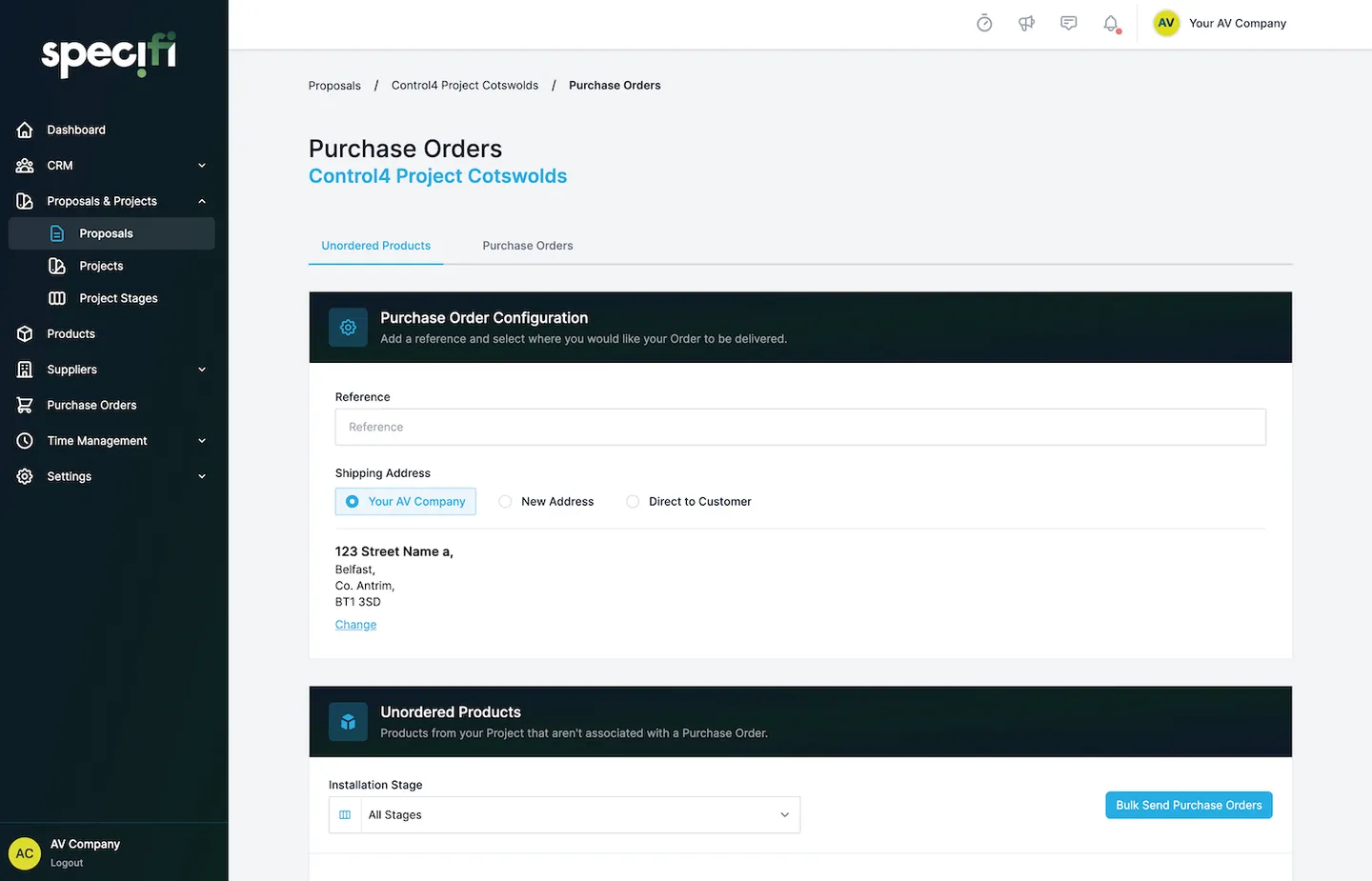
How updates flow from supplier feeds
A lot of "AV product catalogues" are static. Some person, somewhere, updates a CSV every quarter. By the time it reaches your proposal, the cost is six weeks out of date. We do not do that. The Specifi catalogue is connected to roughly 200 supplier feeds today, sitting on top of the Echo distribution layer. The feeds publish daily; the catalogue rebuilds the affected SKUs the same day.
When a supplier bumps a cost, three things happen automatically:
- Any open proposal that uses the SKU is flagged in the integrator's CRM with a "cost has changed" indicator.
- The profitability calculator on that proposal recalculates against the new cost so the margin number is honest.
- If the SKU is on a work order for a project that has not been ordered yet, the project manager gets a notification.
The hard part: keeping it honest
Feeds are the easy part. The hard part is the rules we apply on top of them. Two suppliers in different regions will list the same processor with two different SKUs and two different datasheets and one of those datasheets will be wrong. The catalogue has to know which one is canonical, which one to surface to a UK integrator, and which one to surface to a US integrator. That is the work nobody sees: deduplication, regional gating, and a manual review on every brand-new SKU before it goes live.
A catalogue is not a list of products. It is a set of rules about which version of which product appears in front of which integrator on which day.
Boaz
What integrators see, what suppliers see
There are two surfaces on top of the same catalogue. Integrators see the proposal builder and the order screen: clean SKU pickers, live cost, live lead time. Suppliers see Echo: the dashboard where they can publish promotions, update lead time bands, and see which integrators have specified them on open proposals (no client data is shared). Both surfaces read from the same record. That is the only reason the loop ever closes.
If you are still on a spreadsheet
I am not anti-spreadsheet. The Specifi catalogue started as a spreadsheet. The difference is that one person owns it now, and that person does it full-time. If you are running the catalogue side of the business off four tabs in Google Sheets and you are also doing site walks, you have already built yourself a bottleneck. Book a demo and we will show you what the catalogue looks like inside the platform. If it is not right for you, we will tell you.