

The first thing I had to fix when we started training Bob the AI was that the off-the-shelf models all sound like a press release. Ask a generic large language model to "draft a scope of work for a residential cinema with Trinnov processing and a Dolby Atmos 7.1.4 layout" and you get back 300 words of "leveraging cutting-edge audio solutions to deliver an immersive cinematic experience". No integrator has ever written that sentence. Their clients can smell it in three seconds.
I lead the data and ML team that trains Bob. The job is half engineering and half copywriting. Here is what is actually going on under the hood.
What Bob reads
Bob is not one model. It is a fine-tuned model running inside your specific Specifi workspace, with read access to four things:
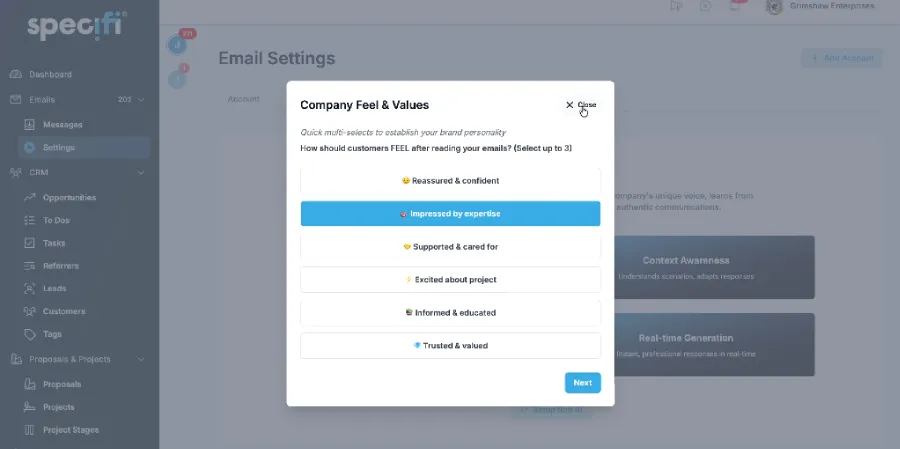
- Your past [proposals](/proposals). Tone of voice, technical depth, the way you describe brands you specify often. If your firm always writes "concealed in millwork" instead of "hidden in cabinetry", Bob picks it up after about 12 proposals.
- Your [client history](/crm). The conversation thread, the type of jobs you have done for this client before, the language they tend to use back. The reply Bob drafts to a returning client reads like the seventh email in a real thread, not the first.
- Your project context. Open work order, site address, install team, scheduled dates. Bob does not have to ask "which project are you on" because the screen you opened him from told him.
- Your [product catalogue](/proposals) preferences. If you tend to specify a particular brand for a given room size, Bob ranks it first in any auto-generated SKU list.
Bob does not read your private payment data, your team's personal calendar entries, or anything outside the workspace. The training is workspace-scoped: the version of Bob that runs for your firm never sees another firm's data, and your firm's data never enters another workspace.
The four things Bob does today
I want to be specific about what is shipped, not what is on the roadmap. As of this article, Bob does four things well:
- Drafts client emails. Replies, status updates, follow-ups. You hit "Bob, draft a reply" and Bob writes one in your tone, with the right project context, ready for you to approve.
- Summarises long threads. A 38-email thread on a commissioning issue becomes a six-bullet status. Useful when you are picking up a job mid-flight from another project manager.
- Writes scope-of-work sections. Give Bob a room and a brief; he drafts the SoW. The first pass is normally 70 percent there. Editing it is faster than starting from a blank page.
- Builds a first-pass [proposal](/proposals) from a brief. You describe the job, Bob picks SKUs from your catalogue, estimates labour from your historical numbers, and produces a draft proposal you then edit.
What Bob is not allowed to do
This is the part I argue about most internally. There are things Bob could do but we have chosen not to ship, on principle:
- Send anything without a human approving it. No auto-send emails, no auto-issue invoices, no auto-publish proposals. Bob drafts. You ship.
- See private financial details. Bob can write a proposal but cannot view personal payment information on a client's record. Different scope, different access.
- Train on data outside the workspace. Your proposals never become training data for another firm's Bob. The audit log says so and the ML pipeline enforces it.
- Pretend to be a human. Every Bob-drafted message includes a small "drafted with Bob" indicator inside Specifi (not in the outbound email to the client). The integrator always knows when they are editing a Bob draft.
An AI for AV that sends emails on its own is a liability waiting to happen. Bob drafts; the integrator decides.
Varel
What is next
The roadmap I am willing to talk about publicly: better voice-to-Bob (talking into the mobile app on a site walk to log notes that become a project update), and a sharper change-order draft path so the moment a client emails "can we also add zone three?" the proposal revision is ready for you to review by the time you get back to the office.
If you want to see Bob inside your tone of voice, book a demo. We will run him against three of your past proposals and let you decide whether the draft sounds like you. If it does not, we will tell you what we need to tune.